Commissioning is one of the most important stages of any electrical project. It is the point where installation work is tested, verified, documented and prepared for safe operation.
For sites with high voltage, low voltage and EEHA systems, commissioning is not just the final step before handover. It is a critical process that protects people, equipment, production schedules and long-term asset performance.
Whether the project involves a new switchboard, transformer, MCC, hazardous area installation, fuel facility, process plant, workshop upgrade or industrial expansion, the quality of the commissioning process can determine how safely and reliably the system operates once it is placed into service.
That is why having the right commissioning team matters.
Commissioning Is More Than Completing the Install
A project is not truly finished when the equipment is installed.
Cables may be terminated, switchboards may be mounted and equipment may look ready, but that does not mean the system has been proven. Commissioning confirms that the electrical installation has been completed correctly, tested properly and is ready to operate as intended.
A strong commissioning process helps identify issues before they become operational problems. This may include wiring faults, incorrect labelling, loose terminations, incorrect protection settings, control circuit issues, documentation gaps or equipment that has not been installed in line with the design requirements.
For clients and project managers, commissioning provides confidence. It confirms that the installation is not only complete, but safe, compliant and ready for service.
HV Commissioning: Controlled, Planned and Documented
High voltage commissioning requires detailed planning, experienced personnel and strict control of the work environment.
In Queensland, a high voltage installation generally refers to permanently connected electrical equipment that can be supplied at voltages greater than 1000V AC RMS or 1500V ripple-free DC. WorkSafe Queensland also notes that HV installations can include associated protection and earthing systems, as well as low voltage cables and switchgear associated with the HV installation.
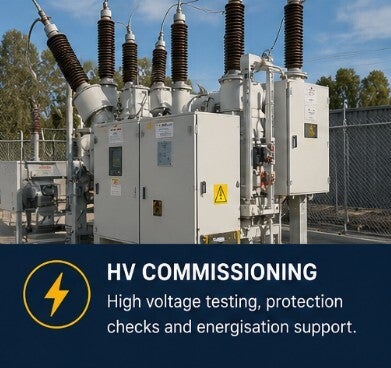
This is why HV commissioning needs to be approached carefully. The work may involve switchgear testing, transformer checks, protection relay verification, cable testing, earthing checks, interlock testing, control circuit testing and preparation for energisation.
WorkSafe Queensland states that HV installation owners and operators should maintain accurate records, including HV schematics, cable location maps, equipment compliance records, commissioning records, maintenance manuals and maintenance plans.
A good HV commissioning team does more than perform tests. They understand switching requirements, safety procedures, documentation, stakeholder coordination and the importance of getting the details right before energisation.
LV Commissioning: The Details Still Matter
Low voltage commissioning is sometimes underestimated because it feels more familiar than HV work. However, LV systems are often where the site’s day-to-day operations depend most heavily on reliable electrical performance.
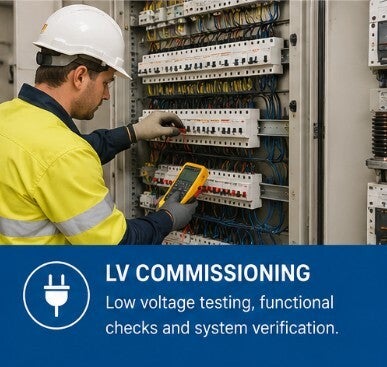
LV commissioning may include switchboard inspections, circuit testing, polarity checks, insulation resistance testing, RCD testing, functional testing, load checks, control system verification, labelling checks and confirmation that equipment operates correctly.
WorkSafe Queensland’s guide for testing low voltage electrical installations states that inspection and testing are carried out to help ensure an installation is electrically safe before being placed into service. It also notes that installation testing records should include the visual inspection, tests performed, test results, the identity or license number of the person responsible and the date of testing.
This documentation is valuable long after the project is complete. It gives the client a record of what was tested, what passed and what was handed over.
A reliable LV commissioning team helps reduce call-backs, avoid nuisance faults and make sure the installation performs the way the client expects from day one.
EEHA Commissioning: Critical for Hazardous Areas
EEHA stands for Electrical Equipment in Hazardous Areas. These are environments where flammable gases, vapours, liquids or combustible dusts may create a fire or explosion risk.
EEHA commissioning requires specialist knowledge because the consequences of incorrect equipment selection, installation or inspection can be serious. WorkSafe Queensland states that where flammable liquids, vapours, gases or combustible dusts are used, stored, handled or generated, a hazardous area classification is required to assess fire and explosion risk.
For electrical equipment installed in a hazardous area classification zone, WorkSafe Queensland identifies specific requirements under AS/NZS 60079.14 for design selection, erection and initial inspection.
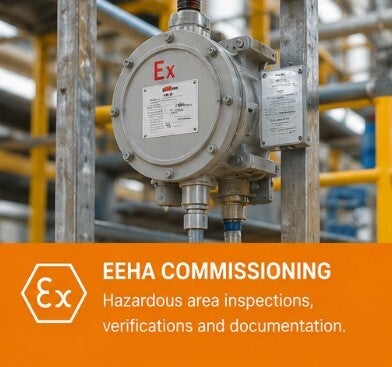
EEHA commissioning may involve checking equipment certification, Ex ratings, temperature class, gas or dust group suitability, cable glands, seals, labelling, installation methods, inspection records and the hazardous area verification dossier.
This is not a tick-and-flick process. The team needs to understand both the electrical installation and the hazardous area requirements. The right team can identify non-compliant equipment, missing documentation or installation issues before they create risk or delay handover.
Why the Right Commissioning Team Matters
Commissioning brings together technical skill, planning, communication and accountability.
The right team understands that every stage matters. They know how to work safely around electrical infrastructure, follow procedures, interpret drawings, complete testing correctly and communicate clearly with clients, builders, engineers, operators and other contractors.
A strong HV, LV and EEHA commissioning team should be able to:
- Review drawings, specifications and site requirements
- Plan the commissioning sequence before arriving on site
- Identify safety risks and control measures
- Perform testing accurately and methodically
- Verify protection, control and safety systems
- Understand hazardous area requirements where EEHA is involved
- Record results clearly for handover
- Communicate issues early and help resolve them efficiently
When the right people are involved, commissioning becomes smoother, safer and more controlled.
Commissioning Protects More Than the Electrical System
Good commissioning protects the whole project.
It helps avoid delays at energisation, reduces the risk of equipment damage, supports compliance, improves reliability and gives the client confidence that the installation is ready for operation.
For industrial and commercial sites, this can make a major difference. Poor commissioning can lead to downtime, production delays, failed inspections, repeated faults or costly rework. Strong commissioning helps prevent those problems before they reach the operational stage.
This is especially important when HV, LV and EEHA systems overlap. A project may involve high voltage supply, low voltage distribution and hazardous area equipment all working together. If one part is not commissioned properly, the whole system can be affected.
Experience Counts When Issues Appear
Even well-managed projects can uncover issues during commissioning.
Drawings may not match the site. Equipment may arrive with different details than expected. Labels may be missing. Protection settings may need review. Hazardous area documentation may be incomplete. Control wiring may need correction.
An experienced commissioning team knows how to work through these issues without rushing or guessing. They understand what needs to be stopped, what can continue and what must be resolved before handover or energisation.
That experience can save time, reduce stress and help keep the project moving safely.
The Outcome: A Safer, Cleaner Handover
The goal of commissioning is not just to get power on.
The goal is to hand over an electrical system that has been tested, verified, documented and prepared for reliable operation.
For HV systems, that means confidence in the switching, protection, earthing and equipment readiness.
For LV systems, it means confidence in the installation, testing, safety and functionality.
For EEHA systems, it means confidence that hazardous area equipment has been selected, installed and inspected correctly.
A quality commissioning process gives asset owners and operators the information they need to maintain the system properly into the future.
Final Thoughts
HV, LV and EEHA commissioning is a critical part of electrical project delivery. It is where the installation is proven, the risks are checked and the client gains confidence that the system is ready for service.
Having the right team on site can make the difference between a rushed handover and a controlled, professional commissioning process.
For industrial, commercial and hazardous area projects, commissioning should never be treated as an afterthought. It should be planned early, carried out carefully and completed by people with the right experience.
When safety, compliance and reliability matter, the right commissioning team matters.
Planning HV, LV or EEHA commissioning?
Planning an electrical project that requires HV, LV or EEHA commissioning? Our experienced team can support your project with testing, verification, documentation and commissioning services to help deliver a safe and reliable handover.
What is HV, LV and EEHA commissioning?
HV, LV and EEHA commissioning is the process of testing, verifying and documenting high voltage, low voltage and hazardous area electrical installations before they are placed into service.
Why is electrical commissioning important?
Electrical commissioning helps confirm that the installation is safe, compliant and operating as intended. It can identify faults, documentation gaps or installation issues before they affect site operations.
What is included in LV commissioning?
LV commissioning may include visual inspections, insulation resistance testing, polarity testing, RCD testing, circuit verification, switchboard checks, functional testing and commissioning documentation.
What is included in HV commissioning?
HV commissioning may include switchgear testing, transformer checks, cable testing, protection relay testing, earthing verification, control circuit testing, interlock testing and energisation support.
What does EEHA commissioning involve?
EEHA commissioning involves checking electrical equipment installed in hazardous areas to confirm it is suitable for the classified zone, correctly installed, correctly documented and ready for safe operation.
Why do you need an experienced commissioning team?
An experienced commissioning team can identify issues early, manage testing safely, understand compliance requirements, communicate clearly and provide accurate handover documentation.