Vehicle-to-Load (V2L): When Your EV Becomes Backup Power
Vehicle-to-Load (V2L): When Your EV Becomes Backup Power
Power outages are a fact of life across Queensland — storms, fallen trees, car vs pole incidents.
What many people don’t realise is that some electric vehicles (EVs) can now supply 240V power during a blackout.
This feature is called Vehicle-to-Load, or V2L.
What is Vehicle-to-Load (V2L)?
V2L allows a compatible electric vehicle to export power from its battery through a dedicated adapter, providing a standard 240V power outlet.
In simple terms: Your EV battery stores energy. A built-in inverter converts it to household power. You plug appliances straight into the vehicle. It’s effectively a silent, zero-fuel generator on wheels.
What Can V2L Power?
V2L is ideal for essential loads, including:
Fridges and freezers
Lights
Internet modems and routers
Phone and laptop chargers
TVs
Small appliances and tools.
During outages, this can mean saving hundreds of dollars in spoiled food and keeping a home comfortable and connected.
How Powerful Is V2L?
Most V2L-enabled EVs in Australia provide around: 2.2kW (10 amps at 240V) That’s plenty for essentials — but it is not designed to run everything at once.
Not suitable for direct V2L use:
Air conditioning
Electric hot water systems
Ovens
Pool pumps
These require a properly engineered and compliant backup system.
How Long Can an EV Run a Fridge?
A modern fridge typically averages 100–150 watts.
With EV batteries commonly between 50–70kWh, a single vehicle can power a fridge for multiple days, even allowing for losses.
Unlike petrol generators:
No refuelling
No noise
No fumes
No maintenance
How Is V2L Used Safely?
There are two compliant ways to use V2L:
1. Direct Plug-In (Most Common)
Appliances are plugged directly into the V2L adapter using extension leads.
This is simple, safe, and ideal for:
Fridges
Lamps
Charging devices
2. Changeover Switch (Licensed Electrician Required)
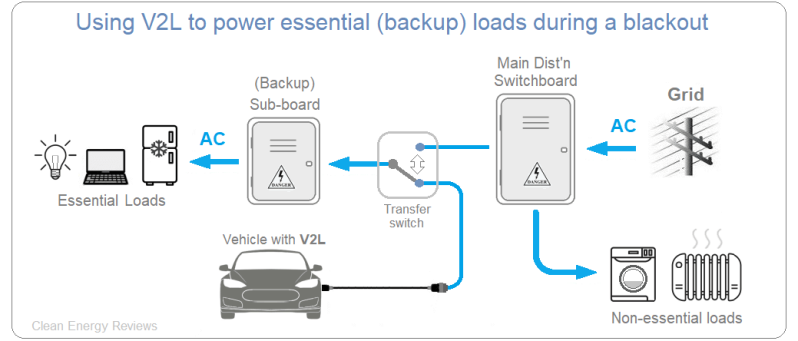
A changeover switch is installed so the EV can power selected circuits only, fully isolated from the electricity grid.
⚠️ Important safety note:
It is illegal and dangerous to back-feed a house via a power point.
Any fixed connection must comply with AS/NZS 3000 and be installed by a licensed electrician.
Which Vehicles Support V2L?
Not all electric vehicles support V2L.
Below are commonly available Australian models known to offer V2L capability (availability may vary by year and trim level):
V2L-Compatible Vehicles (Australia)
BYD
Atto 3
Dolphin
Seal
Sealion
Hyundai
Ioniq 5
Kona Electric (selected variants)
Kia
EV6
EV9
Niro EV
MG
MG4
ZS EV
Genesis
GV60
GV70 Electrified
G80 Electrified
Mitsubishi (PHEV)
Outlander PHEV
Eclipse Cross PHEV
Smart
Smart #1
Smart #3
Always confirm V2L support for your specific vehicle before purchasing an adapter.
Is V2L the Same as Powering the Whole House?
No — V2L is not the same as Vehicle-to-Home (V2H) or Vehicle-to-Grid (V2G).
V2L: Powers appliances directly
Ideal for emergencies and essentials
V2H / V2G: Feeds power into house circuits or the grid requires specialised equipment.
Limited availability in Australia.
Is V2L Right for You?
V2L is an excellent solution for:
Blackouts and storm season
Rural and semi-rural homes
Preventing food loss
Quiet, reliable emergency power
It’s not a full generator replacement — but for essentials, it’s one of the most practical backup options available today.
Need Advice or a Compliant Setup?
At I.C.M, we help homeowners with:
Safe V2L use changeover switch installations, backup power planning
EV charger and load management solutions
If you’d like advice on whether V2L will work for your home — or want it set up legally and safely — get in touch.
📞 07 5465 8439
📧 admin@icmelectric.com
Vehicle-to-Load (V2L): When Your EV Becomes Backup Power to your home
Vehicle-to-Load (V2L): When Your EV Becomes Backup Power to your home
Power outages are a fact of life across Queensland — storms, fallen trees, car vs pole incidents.
What many people don’t realise is that some electric vehicles (EVs) can now supply 240V power during a blackout.
This feature is called Vehicle-to-Load, or V2L.
What is Vehicle-to-Load (V2L)?
V2L allows a compatible electric vehicle to export power from its battery through a dedicated adapter, providing a standard 240V power outlet.
In simple terms: Your EV battery stores energy. A built-in inverter converts it to household power. You plug appliances straight into the vehicle. It’s effectively a silent, zero-fuel generator on wheels.
What Can V2L Power?
V2L is ideal for essential loads, including:
Fridges and freezers
Lights
Internet modems and routers
Phone and laptop chargers
TVs
Small appliances and tools.
During outages, this can mean saving hundreds of dollars in spoiled food and keeping a home comfortable and connected.
How Powerful Is V2L?
Most V2L-enabled EVs in Australia provide around: 2.2kW (10 amps at 240V) That’s plenty for essentials — but it is not designed to run everything at once.
Not suitable for direct V2L use:
Air conditioning
Electric hot water systems
Ovens
Pool pumps
These require a properly engineered and compliant backup system.
How Long Can an EV Run a Fridge?
A modern fridge typically averages 100–150 watts.
With EV batteries commonly between 50–70kWh, a single vehicle can power a fridge for multiple days, even allowing for losses.
Unlike petrol generators:
No refuelling
No noise
No fumes
No maintenance
How Is V2L Used Safely?
There are two compliant ways to use V2L:
1. Direct Plug-In (Most Common)
Appliances are plugged directly into the V2L adapter using extension leads.
This is simple, safe, and ideal for:
Fridges
Lamps
Charging devices
2. Changeover Switch (Licensed Electrician Required)
A changeover switch is installed so the EV can power selected circuits only, fully isolated from the electricity grid.
⚠️ Important safety note:
It is illegal and dangerous to back-feed a house via a power point.
Any fixed connection must comply with AS/NZS 3000 and be installed by a licensed electrician.
Which Vehicles Support V2L?
Not all electric vehicles support V2L.
Below are commonly available Australian models known to offer V2L capability (availability may vary by year and trim level):
V2L-Compatible Vehicles (Australia)
BYD
Atto 3
Dolphin
Seal
Sealion
Hyundai
Ioniq 5
Kona Electric (selected variants)
Kia
EV6
EV9
Niro EV
MG
MG4
ZS EV
Genesis
GV60
GV70 Electrified
G80 Electrified
Mitsubishi (PHEV)
Outlander PHEV
Eclipse Cross PHEV
Smart
Smart #1
Smart #3
Always confirm V2L support for your specific vehicle before purchasing an adapter.
Is V2L the Same as Powering the Whole House?
No — V2L is not the same as Vehicle-to-Home (V2H) or Vehicle-to-Grid (V2G).
V2L: Powers appliances directly
Ideal for emergencies and essentials
V2H / V2G: Feeds power into house circuits or the grid requires specialised equipment.
Limited availability in Australia.
Is V2L Right for You?
V2L is an excellent solution for:
Blackouts and storm season
Rural and semi-rural homes
Preventing food loss
Quiet, reliable emergency power
It’s not a full generator replacement — but for essentials, it’s one of the most practical backup options available today.
Need Advice or a Compliant Setup?
At I.C.M, we help homeowners with:
Safe V2L use changeover switch installations, backup power planning
EV charger and load management solutions
If you’d like advice on whether V2L will work for your home — or want it set up legally and safely — get in touch.
📞 07 5465 8439
📧 admin@icmelectric.com